
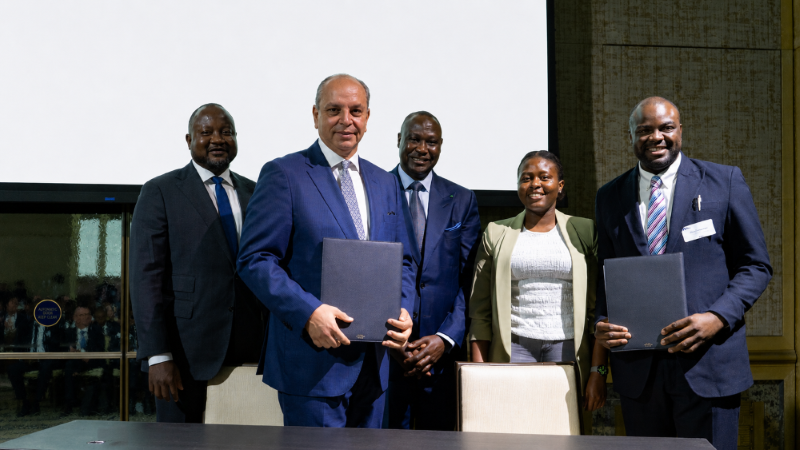
The Africa Finance Corporation (AFC) board has approved a US$100 million investment commitment to Africa-focused technology fund managers, signaling a structural pivot in how the continent’s developmental architecture views digital assets. The strategic move targets the acceleration of “digital industrialisation,” repositioning tech-enabled enterprise as core infrastructure equivalent to physical networks. The initiative arrives at a critical juncture, as Africa’s digital economy is projected to contribute over US$700 billion to gross domestic product by 2050, driven by rapid enterprise technology adoption and a fast-growing connected population.
Under the initial deployment phase, the pan-African multilateral lender has approved anchor commitments to two vehicles, allocating US$25 million to the growth-stage Lightrock Africa Fund II and US$15 million to the early-stage Future Africa Fund III. The capital targets institutional-grade managers addressing structural bottlenecks in financial inclusion, digital utilities, consumer technology, and education. By channeling capital through these institutional-grade, Africa-focused managers, the corporation leverages its balance sheet to reconstruct ecosystem cap tables, build local General Partner (GP) capacity, and ensure investment decisions are guided by native market intelligence.
This programmatic push directly confronts the historical composition of African venture capital, which has traditionally been dominated by foreign development finance institutions (DFIs), international venture funds, and offshore private capital. This heavy external dependency has left the tech ecosystem highly exposed to global monetary tightening and international capital flight, as witnessed during the severe venture funding contractions between 2023 and 2024. Additionally, while up to 80% of regional venture deals involve tech or tech-enabled firms, the vast majority of this capital has historically flowed into offshore-domiciled entities, depriving local economies of taxable gains, intellectual property, and local asset-management track records.
The AFC’s deployment aims to mobilize Africa’s massive domestic institutional asset pools, which manage an estimated US$2 trillion out of the continent’s US$4.4 trillion in total domestic wealth. Historically, this local pension and insurance capital has remained largely frozen in government debt due to regulatory bottlenecks and trustee risk aversion. In Kenya, for instance, Retirement Benefits Authority (RBA) guidelines permit up to a 10% allocation to alternative assets like private equity, yet actual deployment stays below 1% due to regulatory ambiguity and a lack of viable pipelines. Similarly, South Africa’s Regulation 28 of the Pension Funds Act limits private equity allocations to 10%, though active proposals aim to raise this ceiling to 15% to catalyze real-economy investments.
To bridge this risk-mitigated intermediation gap, specialized fund-of-funds structures are proving essential to unlocking conservative capital pools at scale. A key regional precedent is the recent first close of the Ci Gaba Fund of Funds, the first domestically domiciled private fund-of-funds in West Africa, at GHS 383 million (approximately US$35 million) toward a GHS 1 billion target. Driven by a policy push targeting a minimum 5% allocation of pension assets to private markets, Ghanaian pension funds accounted for over two-thirds of the fund’s initial commitments, demonstrating a viable model for local ownership and domestic resource mobilization.
At the core of this shift is the strategic treatment of digital platforms, governing payments, logistics, cross-border trade networks, and data storage, as the contemporary equivalents of roads, rail, and ports. Satisfying the continent’s growing demand for data centers alone could require up to US$20 billion in cumulative investment, a requirement made exponentially more urgent by global artificial intelligence adoption and compute-heavy technologies. By transitioning the funding gravity from volatile foreign capital to local institutional investors and African-owned managers, the ecosystem steps closer to establishing long-term financial autonomy and closing the continent’s US$1.3 trillion annual investment funding gap.
You may also like
-
Global Innovation Fund Secures $50M for Evergreen Blended Debt Vehicle in Emerging Markets
-
ARAF Secures $90 Million for Fund Two to Scale Climate-Resilient Agribusiness Across Africa
-
Impact Fund Denmark Deploys EUR 25m to NSIA Banque Côte d’Ivoire to Scale MSME and Green Credit
-
NADF Partners with Convergence to Mobilize Institutional Private Capital for Nigerian Agribusiness
-
Impact Investing Ghana and Savannah Impact Advisory’s New Framework Outlines Path for Mobilizing Domestic Capital in Emerging Markets