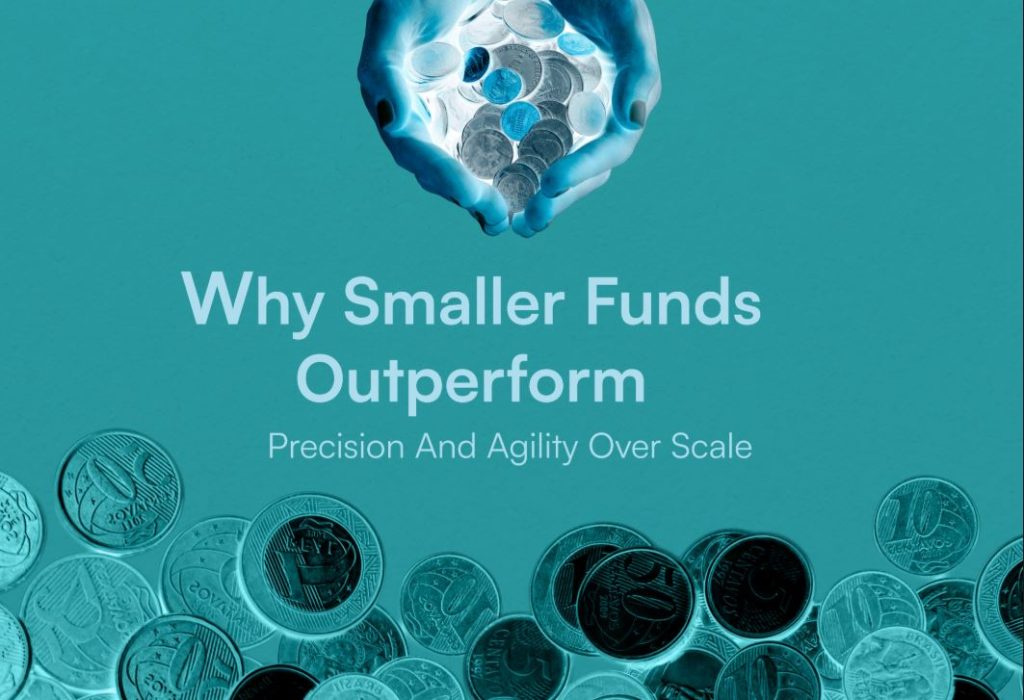
A growing body of evidence suggests that smaller private capital funds consistently deliver stronger returns than their larger counterparts, according to a new report from Aruwa Capital Management. The analysis, Why Smaller Funds Outperform: Precision and Agility Over Scale, synthesises data from Cambridge Associates, PitchBook, and McKinsey showing that smaller and midsized funds have delivered IRRs between 15 and 18 per cent across multiple vintages, compared with 9 to 10 per cent for large funds. Research from CARTA cited in the report shows an even wider gap: smaller funds achieved a 43.7 per cent IRR against 21.5 per cent for larger vehicles.
The report notes that limited partners are increasingly prioritising alignment, impact and differentiation in their investment strategies, favouring vehicles where mission, focus and performance metrics are clearly defined over broad, sector‑agnostic funds. Across global markets, several established firms have responded by creating smaller or thematic vehicles focused on sustainability, gender inclusion or regional specialisation. Despite this shift, the majority of institutional capital flowing into Africa continues to be directed toward mid‑to‑large vehicles. A review of recent commitments from one of the continent’s most active development finance institutions found that roughly two‑thirds of allocations supported funds targeting $200m or more, reinforcing a concentration around mid‑to‑large vehicles that often sidelines the smaller, more nimble managers populating the African fund management landscape.
Among funds below $50m, 27 per cent achieved returns above 2.5x TVPI, compared with 24 to 25 per cent for funds in the $50m to $350m range. The report notes that a smaller fund is roughly 50 per cent more likely to return more than 2.5x than a large fund. The structural advantages underpinning this performance include access to less competitive deals at lower entry multiples, greater capital efficiency, faster deployment, and deeper operational engagement with portfolio companies. McKinsey research cited in the report found that small and mid‑market buyouts outperform large‑cap peers by up to 400 basis points in IRR due to hands‑on value creation.
For impact‑focused investors, the case for smaller funds extends beyond financial returns. The report notes that smaller vehicles often achieve more concentrated impact outcomes because of their ability to engage directly with founders and SMEs—the enterprises that form the backbone of African economies. Aruwa’s own portfolio, presented as a case study, illustrates this dynamic: its investments have grown direct employment from approximately 745 to 2,470 jobs, with female participation increasing from 298 to 1,030. Aruwa Capital, a Lagos‑based, female‑founded growth equity firm focused on West African mid‑market SMEs, is the report’s author.
The report also points to a broader shift in global private markets, with established managers such as AgDevCo, AfricInvest, Helios Investment Partners, and Adenia Partners launching smaller, more targeted vehicles alongside their flagship funds. For limited partners, a modelled allocation shows that deploying $2bn exclusively into large funds at a 9.7 per cent IRR grows to $5.04bn over ten years, while a 50/50 split between large and smaller funds increases that to $7.49bn. As one cited analysis puts it, “the administrative burden of smaller‑fund diversification is the cheapest alpha an allocator can buy.” The authors caution that smaller funds carry higher idiosyncratic risk due to concentrated portfolios, but argue that proper due diligence can capture their alpha potential while managing downside.
You may also like
-
Small Foundation Anchors AgDevCo Ventures to Target East Africa’s Agribusiness Missing Middle
-
Impact Fund Denmark Joins $600M Sustainability-Linked Facility for ETG to Target Agricultural Working Capital Deficit
-
Global Innovation Fund Secures $50M for Evergreen Blended Debt Vehicle in Emerging Markets
-
ARAF Secures $90 Million for Fund Two to Scale Climate-Resilient Agribusiness Across Africa
-
Impact Fund Denmark Deploys EUR 25m to NSIA Banque Côte d’Ivoire to Scale MSME and Green Credit