
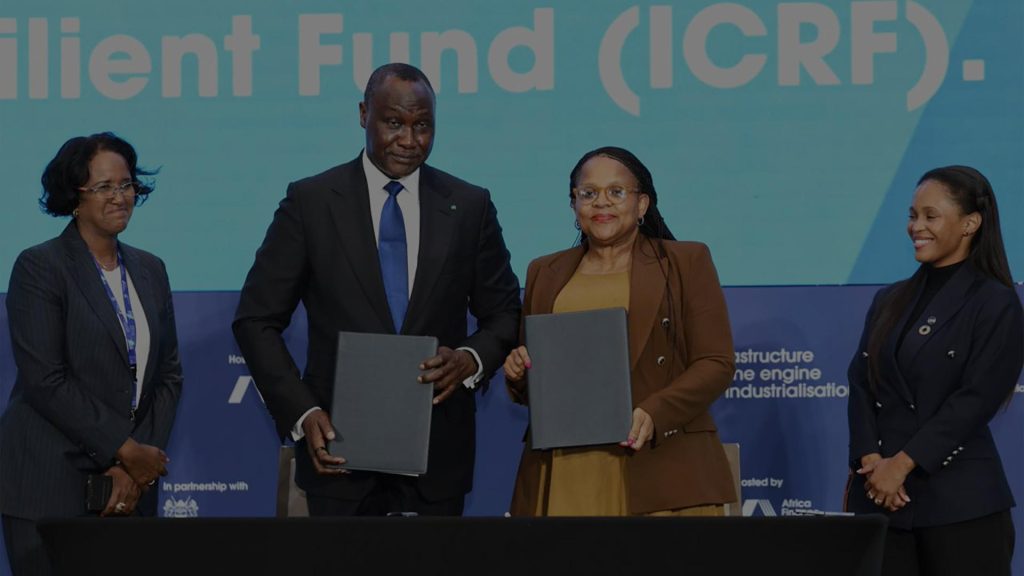
The Development Bank of Southern Africa (DBSA) has committed capital to the Africa Finance Corporation’s (AFC) US$750 million Infrastructure Climate Resilient Fund (ICRF), anchoring a coordinated regional effort to embed resilience across the continent’s infrastructure assets. The agreement, signed at The Africa We Build Summit in Nairobi, formalizes institutional alignment around adaptation finance, a sub-sector that has historically struggled to attract commercial-scale capital despite the continent losing an estimated 2% to 5% of GDP annually to climate shocks.
Managed by AFC Capital Partners (ACP), the ICRF targets a total capitalization of $750 million and is intended to mobilise up to $3.7 billion in total financing. The vehicle utilizes a blended finance structure, anchored by a US$253 million equity commitment from the Green Climate Fund (GCF) – its largest ever in Africa – alongside the European Investment Bank (EIB), and the Nigeria Sovereign Investment Authority (NSIA). By deploying concessional capital to absorb risk, the fund lowers the barrier for institutional entry into transport, logistics, and renewable energy sectors central to low-carbon economic growth.
The facility addresses a fundamental gap in global climate architecture and African project finance. Despite Africa contributing less than 4% of global carbon emissions, African infrastructure remains uniquely exposed to climate-related disruptions. The ICRF reframes climate adaptation as a distinct, investable asset class. By integrating resilience into the design phase of ports and power grids, the fund aims to protect the long-term valuations of assets that are increasingly threatened by “one-in-a-hundred-year” weather events. Africa has adaptation needs reaching up to $50 billion each year.
The DBSA’s participation underscores the role of Africa’s infrastructure systems as a catalyst for regional integration, and reflects a growing push toward domestic resource mobilization and reduced dependence on foreign, non-resilient financing models. With Africa’s infrastructure gap estimated at $200 billion annually, the fund’s focus on “climate-proofing” assets accelerates investment in climate-resilient infrastructure.
The ICRF targets a diversified portfolio of 10 to 12 high-impact infrastructure projects, focusing its strategy on integrated ecosystems – systems that link production, transport, and energy – rather than isolated assets.
You may also like
-
FSD Africa, FMO, and FCDO Launch Manager Finance Facility to Capitalize Emerging Local Fund Managers
-
IFC Deploys $53M Blended Facility with Absa Bank Ghana and Complete Farmer to Scale Ag-Finance
-
Airnergize Capital Secures R3.89 Billion Final Close to Scale Clean Energy, Water, and Gas Infrastructure Across Southern Africa
-
Sahel Capital Deploys $650,000 SEFAA Facility to Noma Services to Scale Commodity Aggregation, and Smallholder Support in Nigeria
-
PIDG, IFDK, and Sanlam Back USD 21.5m Third Close for Africa GreenCo to Scale Renewable Energy Capacity Across Southern Africa