
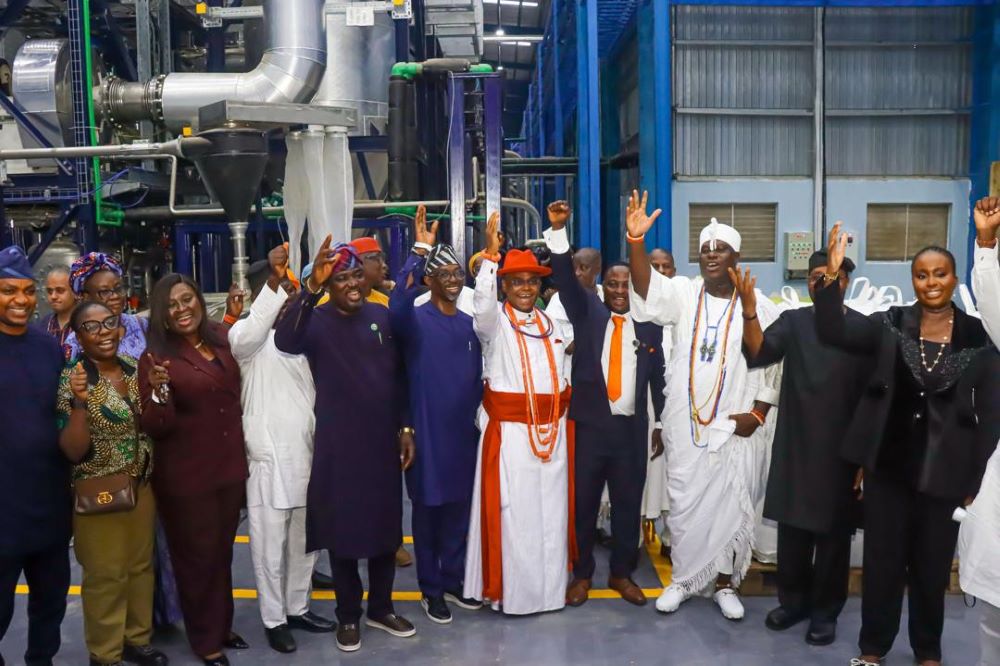
Phase 1 of the Mowe expansion is the first stage of a plan to raise food-grade rPET capacity nearly ninefold, with identified demand more than three times planned output
Aruwa Capital Management has announced its investment in Polysmart Packaging Limited, a fully integrated plastic recycling and packaging solutions company in Nigeria, alongside the commissioning of Phase 1 of the company’s expanded recycling facility in Mowe, Ogun State.
Commissioned in October, the new food-grade recycled polyethylene terephthalate (rPET) production line is built to US Food and Drug Administration (FDA) and European Food Safety Authority (EFSA) food-contact standards. Aruwa said it positions Polysmart, an indigenous Nigerian company, as Africa’s largest food-grade rPET producer.
Aruwa, a growth equity and gender lens investor in Nigeria and Ghana, invested through its sophomore fund, Aruwa Capital Fund II, in December 2025 to support the expansion. It is the first institutional equity investor in the company.
Founded in 2013 as a flexible packaging business, Polysmart has expanded into PET recycling to address Nigeria’s growing plastic waste challenge and increasing demand for sustainable packaging. It produces food-grade rPET flakes and resin pellets for blue-chip beverage and fast-moving consumer goods (FMCG) manufacturers.
Wasiu Balogun, Polysmart’s founder and chief executive, said Aruwa’s support helped the company bring Phase 1 to commissioning and positions it to build the food-grade recycled resin supply that Nigeria’s beverage and FMCG brands will increasingly need under new regulations.
Through the expansion, Crystal Polymers, its food-grade recycling business, will increase its rPET capacity nearly nine times. Axis Recycling, which processes non-food-grade material, will more than quadruple its capacity. Total recycling capacity across the group will rise more than six times, an additional 66,380 tonnes a year.
The expansion is being delivered in two phases. Phase 1 comprises the first stage of the food-grade rPET expansion and the new non-food-grade recycling line. Phase 2, expected to be completed in the second half of 2027, will bring the food-grade operation to its full planned capacity.
With Phase 1 now commissioned, production will ramp up progressively as the company completes customer validation and technical approvals. Identified demand from existing and prospective domestic and international customers represents more than three times the expanded food-grade facility’s planned production capacity.
Nigeria consumes an estimated 1,094 kilotonnes of plastic annually, of which approximately 602 kilotonnes is used in packaging. Less than 12% of the country’s plastic waste is currently recycled, with the vast majority ending up in landfills, drainage systems or water bodies.
Total annual demand for PET in Nigeria stands at approximately 625,000 tonnes, of which demand for rPET is estimated at 150,000 tonnes. Domestic rPET production capacity was only around 30,000 tonnes per annum before this expansion, an estimated annual supply gap of 120,000 tonnes.
The Nigeria PET packaging market was valued at approximately $370 million in 2025 and is expected to grow to nearly $594 million by 2034. Demand for food-grade recycled resin is set to rise further as Nigeria’s regulatory framework for plastic waste management requires PET packaging to contain 25% recycled content by 2028. An anticipated rPET supply deficit in Europe also presents a potential export opportunity for scaled, quality-certified producers such as Polysmart.
Polysmart’s European washing and pelletising lines deliver the decontamination, product consistency and regulatory compliance that leading beverage companies require for bottle-to-bottle recycled material, in a market with limited local supply of Grade A pellets. A dedicated non-food-grade washing line supports a zero-waste objective by monetising lower-grade fractions for polyester fibre and other industrial applications. Aruwa said this makes Polysmart one of the few facilities in Nigeria and Africa where 100% of input raw material is recycled and monetised.
The company operates a distributed collection model with 21 collection sites across the country. These aggregate PET bottles from households and informal waste collectors across multiple regions of Nigeria, improving waste recovery while supporting livelihoods across the recycling value chain.
At full capacity, the expanded facility is expected to deliver significant economic and environmental impact. Polysmart is expected to create 1,000 direct jobs and support more than 50,000 indirect jobs across its collection network, divert around 6.5 billion PET bottles annually from the waste stream, and avoid approximately 170,000 tonnes of CO₂ emissions annually. By producing locally the food-grade virgin resin that brand owners would otherwise import, it is also expected to save Nigeria around $72 million a year in foreign exchange.
Alongside its capital, Aruwa has worked closely with Polysmart to build the institutional foundations for its next phase of growth. It supported the reconstitution of the board, which now operates under an independent chairman, a formal board charter and four active board committees, with 40% female representation.
Adesuwa Okunbo Rhodes, founder and managing partner of Aruwa Capital, said Polysmart is proof that “world-class manufacturing can be built, owned and run in Nigeria”. Rhodes described an indigenous company with a female-led management team that sits at the intersection of environmental sustainability, manufacturing excellence and import substitution, and called the investment an example of what patient capital in the “missing middle” makes possible. Aruwa looks forward to supporting the team through Phase 2 and beyond, Rhodes said.
Aruwa is also working with Entrepreneurial Solutions Partners (ESP), its technical assistance partner under the Mastercard Foundation Africa Growth Fund, to support the implementation of an enterprise resource planning (ERP) system across the group. Polysmart has strengthened its senior leadership team in parallel, appointing a new Deputy Group Managing Director and adding commercial and technical leadership roles as the business moves from construction into scaled operations.